
What AI Chatbots Can Teach Us About Unmet Legal Needs


Generative AI is creating a foundational shift in how we work, relate to each other, and access information.
Despite growing public discussion about its potential role in the justice system, we still know remarkably little about how ordinary people are already using generally available tools like ChatGPT when they encounter legal problems. In turn, we are overlooking what those interactions can tell us about our justice system itself.
To understand this shift, researchers at JUSTICE and the Administrative Fairness Lab came together to conduct the first large-scale study of public use of AI chatbots for legal help. Rather than asking people hypothetical questions about how or whether they might use AI, we asked about their actual experiences and, crucially, invited them to share the conversations they had already had with general-purpose chatbots. This blog shares some insights and example chats from this dataset.
The chat dataset
From December 2025 to January 2026, we surveyed 3,287 people through Prolific, using quotas to produce a sample that was nationally representative by age, gender, and ethnicity. Of this sample, 1,428 people reported a legal dispute in the last two years – almost half. Among them, 233, or 16.3%, said they had used an AI chatbot for ‘help, information, or advice’ in relation to it. This means that approximately one in six participants with a recent legal problem had used a generative AI chatbot for some form of legal help.
The extent of chatbot use in the sample varied significantly by age. Among the youngest in the sample, 18-24-year-olds, 26% of those with a recent legal problem had used a chatbot, compared with 10% of those aged 55 to 64. This is not explained by younger respondents having a greater incidence of legal problems, since this was broadly flat across all age bands in the sample.
Participants who had used a chatbot were then invited to share anonymised examples of these conversations, as screenshots or pasted text. Seventy-seven did so, around one third of the 233. These conversations form the qualitative part of the study and, to our knowledge, constitute a unique dataset for independent researchers: real conversations between members of the public and AI tools about live legal problems, unmediated by researcher prompts or hypothetical scenarios, though with an obvious selection effect in which chats people chose to share.
The substantive content of the prompts reflects the breadth of everyday civil justice problems. Consumer disputes were common, with participants seeking help about faulty goods, delayed repairs, refunds and disagreements with retailers. Housing and landlord-tenant issues also featured prominently, including tenancy deposits, evictions, rent disputes and conflicts with neighbours. Employment disputes formed another category, with participants asking about dismissal, discrimination, workplace grievances and employment rights. Alongside these, participants sought assistance with family law, medical negligence, debt collection, insurance disputes and court procedures. Taken together, the conversations suggest that people are turning to AI chatbots for problems that are common, stressful, and often difficult to navigate without advice, but that largely fall outside the scope of legal aid.
The rest of this post sets out the kinds of help people sought from these tools, illustrated with the conversations themselves. All quotations are verbatim, typos included.
Asking for legal advice and information
The most widespread use across the sample is the direct questions about legal rights and options. This spanned a range of substantive areas, such as questions about consumer law, tenancy deposits, or unfair dismissal. Participants also asked about processes: what to expect from court, how to prepare, and where to take a complaint.
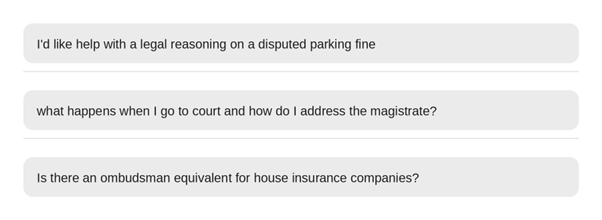
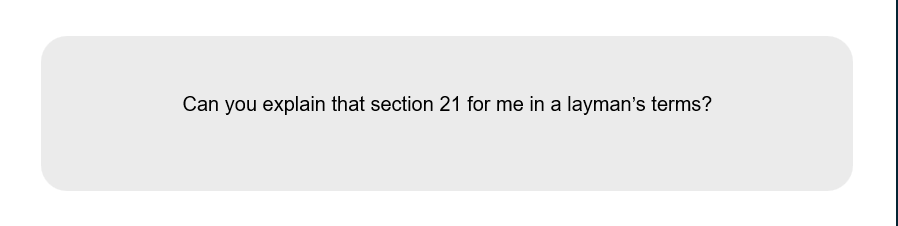
When asking for explanations of legal concepts, several participants took the opportunity to specify in their prompts that they wanted the answer in simple terms – no legalese, please!

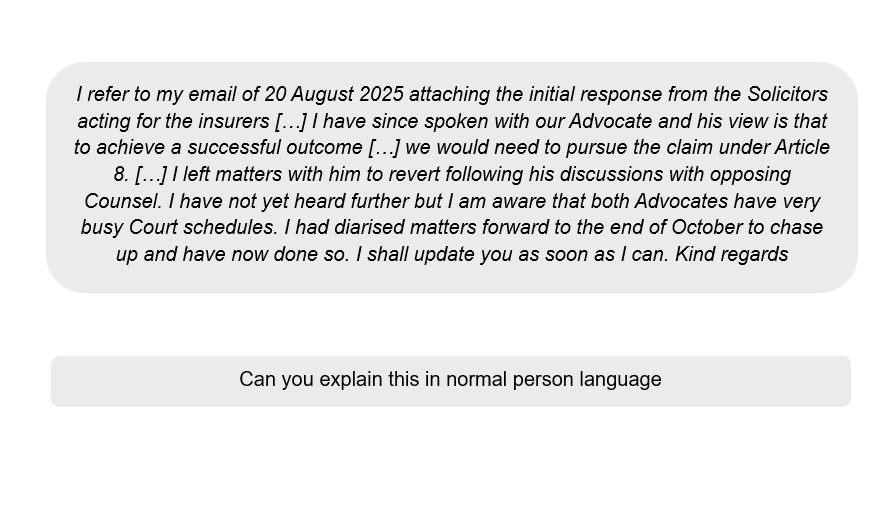
And in another example of a participant struggling with legalese, one chat featured a copied-and-pasted email from that person’s own lawyer, asking for it to be explained in “normal person language”.
Checking the lawyers
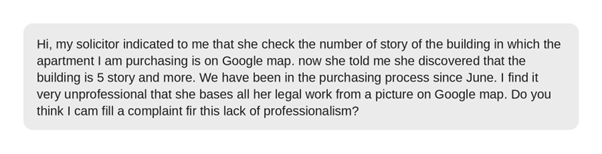
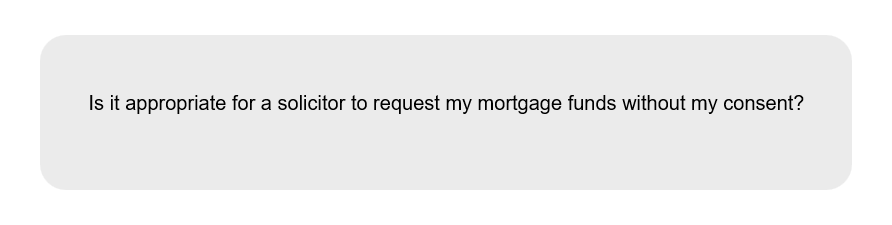
Aside from translating legalese, some participants who already had legal representation used the chatbot to query and check the service they were receiving from their lawyers. Here, the tool provides a second opinion on whether a solicitor’s conduct was reasonable or might ground a complaint. For instance, one participant was unimpressed to learn that their conveyancing solicitor had verified a building’s height using Google Maps.
Another sought help on contextualising their solicitor’s actions in terms of what was normal for solicitor practice.
Help with drafting: edits and templates
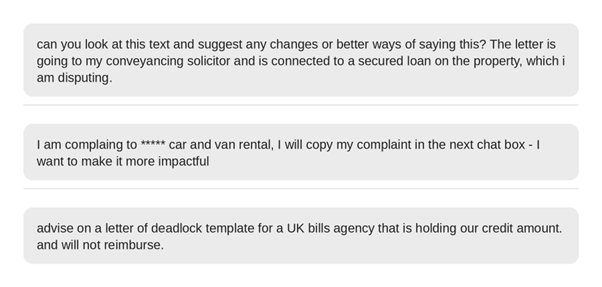
The use of chatbots as drafting assistants was one of the most frequent patterns in the conversations. In many cases, participants arrived with text they had already written and asked the chatbot to improve it: to suggest ‘better ways of saying this’, to make a complaint ‘more impactful’ or, in other situations, friendlier and less confrontational. Others asked for a template they could adapt.
Help with drafting: take the reins
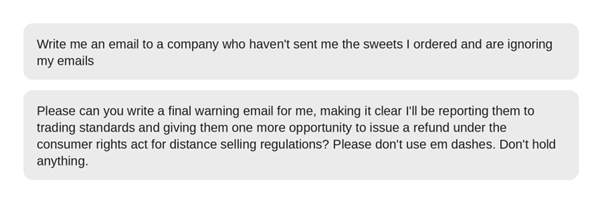
Participants also asked chatbots to write correspondence from scratch, including complaint letters, refund requests and formal warnings.
In stressful situations, participants used AI to prepare for difficult conversations. One, contacted by a bailiff about council tax on a property they had left months earlier, asked the chatbot for ‘a script for me to say on the phone’.

Support and reassurance
Beyond legal advice, many conversations revealed users looking for emotional support. Participants described feeling frightened about court proceedings, worried about losing their job, and overwhelmed by the uncertainty of ongoing disputes. Some asked explicitly whether there was “emotional support” available, while others told chatbots they felt “lost and powerless” and sought reassurance about what might happen next.
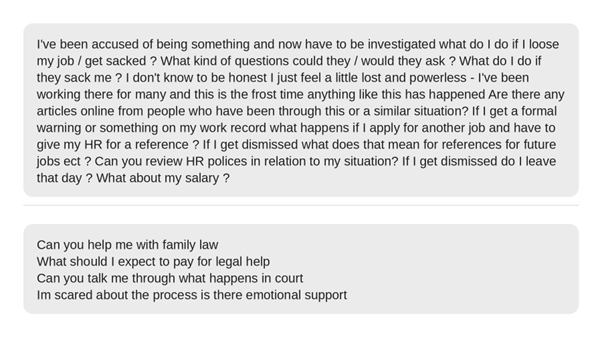
We already know from existing research that legal problems are often experienced as emotional as well as legal events. These conversations demonstrate that individuals are seeking help with both legal and emotional aspects from chatbots, not just information provision.
Another example shows a participant seeking validation when describing a potential medical negligence claim, asking the chatbot whether it agreed with their assessment of the situation.
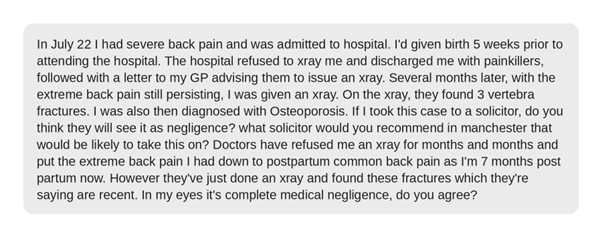
People seeking help with both emotional and legal support may at first seem positive – emotional and legal support needs arise concurrently so a combined solution may seem ideal. However, there is a growing concern about the impact of training AI chatbots to be friendly and validating, with evidence suggesting that it makes them more likely to make mistakes and reinforce false beliefs. This raises the question of whether, by seeking emotional support as well as legal help from these chatbots at the same time, users may unwittingly set themselves up to receive less reliable advice.
A window into unmet need
Our findings suggest that people are not just using AI for legal information. Chatbots are helping people understand unfamiliar language, navigate emotionally difficult situations, and communicate more effectively during legal disputes. This wider support is central to people’s experience of the justice system, yet is often difficult to obtain through existing legal support.
Our findings also suggest that chatbots are supplementing other sources of help rather than replacing them. Of the chatbot users in our sample, only 6% used the AI tool alone. The average chatbot user drew on 3.7 sources, compared with 1.9 for everyone else (e.g., family and friends, search engines, Government websites, etc.). Chatbot users were, however, less likely than others to have sought the advice of a solicitor for their legal dispute (33.9% of chatbot users versus 44.6% of non-users), but were somewhat more likely to have gone to Citizens Advice or a legal advice helpline.
This suggests that people using these tools are already those with the digital means to get some support - albeit in the context of the limited availability of formal legal advice across much of the country. Whereas, for those who are digitally excluded, and whose legal needs are most likely to go unmet, it suggests the problem may become even more acute. Relevant here is the demographic data for those who used chatbots: they were younger, more likely to be male, and more likely to be employed than those who did not use chatbots. This suggests that those with unmet legal need who are women, older or unemployed are not benefiting equally from this technology, and indeed the justice gap for them may be widening, not closing, with the advent of these new technologies.
None of this should be read as a criticism of the people using these tools. Participants were getting drafting help, explanation, and reassurance that they evidently could not obtain elsewhere, even when they had other kinds of help to hand. There is a potential role for AI tools in meeting needs the justice system has long struggled to address.
These chat conversations raise a number of questions that future research should address, including the quality of the tools' replies, in addition to the prompts. It will also matter whether people act on what chatbots tell them, and what consequences that has for how their disputes are resolved. Our next steps include follow-up interviews with participants to begin exploring these questions. What is already clear is that a significant minority of people with legal problems are turning to these tools, and that their conversations offer an unusually direct record of unmet legal need.