The Law for Lawmakers Podcast


The Law for Lawmakers podcast is for anyone who cares about how laws are made, how rights are protected, and how our democratic institutions function.
Together with leading voices from law and politics, it explores the key legal principles that shape our society, and demystifies the role that Parliament plays in upholding them.
This podcast is based on JUSTICE’s Law for Lawmakers guide, which is designed to help repair the cracks in the UK’s political foundations by giving every MP the tools they need to act as custodians of our democracy. But this podcast isn’t just for politicians – it invites a wider audience to the conversation of how our laws are made.
Introductory episode
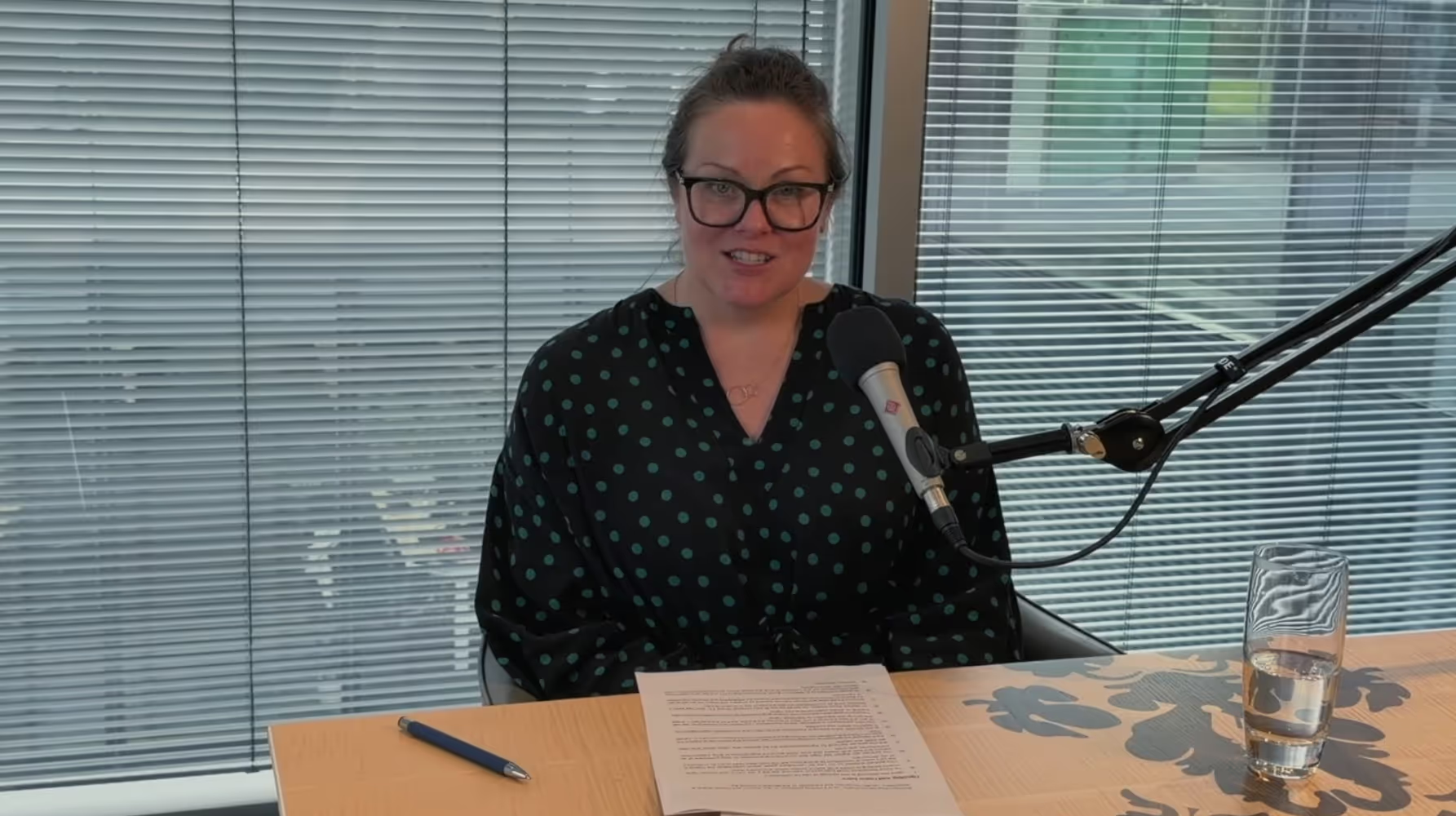
In this introductory episode, host and JUSTICE Chief Executive Fiona Rutherford is joined by JUSTICE’s Legal Director Stephanie Needleman and Interim Director of Strategy Tyrone Steele to set the scene for the series by introducing Law for Lawmakers and the constitutional principles that underpin it.
They explore why understanding public law isn’t just an academic exercise, but a practical tool for holding power to account and safeguarding democratic life in the UK.
Subscribe to Law for Lawmakers via Spotify
Subscribe to Law for Lawmakers via Apple Podcasts
Episode 1: Dominic Grieve KC
In episode one, Dominic Grieve KC, former Attorney General for England and Wales and chair of the Intelligence and Security Committee from 2015 to 2019, explains what Parliamentary sovereignty – the principle that Parliament is the UK’s supreme legal authority - means today.
Grieve warns that MPs and peers are losing control of lawmaking by continually passing laws which hand the Government “vastly excessive” powers to change legislation without a vote in Parliament.
He tells JUSTICE’s Chief Executive and host of the podcast, Fiona Rutherford, that the growing use of these ‘Henry VIII’ powers – now used to create most laws – “subverts Parliament’s role” and risks undermining the constitution. “It's the Achilles heel of our government system,” he says.
Just last year, the Court of Appeal upheld a ruling that the previous Conservative government unlawfully used Henry VIII powers to crack down on peaceful protest, by redefining legislation to expand police powers - despite Parliament having already rejected the change in a vote.
To guard against similar overreach, Grieve calls for Henry VIII powers and other statutory instruments to be granted “very sparingly”, with Parliament reserving the right to change them.
Subscribe to Law for Lawmakers via Spotify
Subscribe to Law for Lawmakers via Apple Podcasts
Episode 2: Baroness Shami Chakrabarti
In episode two, Baroness Shami Chakrabarti shares her experiences of holding power to account over a high-profile career in both law and politics.
After qualifying as a barrister and joining the Home Office as in-house counsel, Baroness Charkrabarti led human rights group Liberty, becoming a prominent critic of anti-terror legislation introduced by her former employer. In 2016, she was made a Labour peer, serving as Shadow Attorney General for England and Wales for four years.
She describes this path as a “continuum” that remained consistent with her values throughout. “All that's happened is that I've perhaps sometimes changed perspective, and seen how different communities engage with lawmaking,” she tells Fiona Rutherford.
Reflecting on her role in opposing then Prime Minister Boris Johnson’s decision to suspend Parliament in 2019, Baroness Chakrabarti underscores the importance of legal safeguards in checking state overreach.
“Without the rule of law, enforced by things like judicial review of administrative action, what's to stop any government, of whatever stripe, coming to power with a landslide majority and abolishing rights and freedoms… This idea that the law is somehow anti-democratic is something that we really have to push back on.”
Elsewhere in the episode, she raises her concerns about recent anti-protest legislation, suggesting that moves to suppress dissent through the law represent “the real cancel culture.”
“Not everybody owns a national newspaper or has millions of followers on social media. Sometimes people need to come together and even be together and demonstrate physically on the street. The idea that that should be suppressed is something that just feels so un-British to me.”
Subscribe to Law for Lawmakers via Spotify
Subscribe to Law for Lawmakers via Apple Podcasts
Episode 3: Sir Robert Buckland
In episode three of the Law for Lawmakers podcast, former Justice Secretary Sir Robert Buckland draws upon his experiences at the top of government to shed light on the role of the executive in upholding the Rule of Law.
Born in Wales, Sir Robert qualified as a barrister in 1991 and practised criminal law for nearly two decades. Elected as a Conservative MP in 2010, he served as Solicitor General, Minister for Prisons, and then Justice Secretary.
Addressing challenges to the Rule of Law in this episode, Sir Robert warns that a culture of increasing personal attacks has left judges fearing for their safety, putting judicial independence at risk.
“We are seeing an increasing naming of judges, individual judges, which I think is leading not just to security concerns, but also real fears amongst the judiciary that they are becoming the targets of ire and opprobrium, and their job is that their working life is no longer a safe one. This is crazy.”
While defending people’s right to comment on and critique court rulings, he urges the media and politicians to criticise verdicts responsibly, bearing in mind the pressures judges face.
In this climate, he adds, it is crucial that the Justice Secretary acts on their duty to protect the judiciary from politicisation.
Elsewhere in the interview, Sir Robert expresses his opposition to calls for the UK to withdraw from the European Convention on Human Rights (‘ECHR’).
Leaving the convention could jeopardise security arrangements in Northern Ireland, as well as post-Brexit trading agreements with the EU, he warns.
If it serious about addressing challenges arising from migrant flow and asylum seeking, the UK needs to work with its international partners, not isolate itself from them, he adds.
“Our tradition is to get involved and to lead. It is no coincidence that Britain is one of the largest economies in the world with a global reach.”
Subscribe to Law for Lawmakers via Spotify
Episode 4: Karl Turner MP
In episode four of the Law for Lawmakers podcast, Karl Turner MP discusses the role of Parliament in scrutinising legislation, drawing on his experiences opposing the government’s plans to restrict jury trials.
Turner, who represents Kingston upon Hull East, has been one of the most outspoken critics of the Courts and Tribunals Bill over recent months.
Reflecting on his role in Parliament, he stresses the importance of MPs and peers having adequate time to scrutinise legislation in detail. This process exposes flaws in new legislation while they can still be addressed, he says, which is crucial since laws are rarely repealed, making their consequences long-lasting.
He argues that the House of Lords’ un-elected nature frees it to prioritise expertise over politics. “It's a safeguard for policies which are not thought through,” he tells Fiona Rutherford, and suggests that peers could block the Courts and Tribunals Bill.
Addressing jury reform, Turner describes the government’s plans as “utterly despicable”. He draws a contrast with the Prime Minister’s concerns earlier in his career about judge-only courts in Northern Ireland.
Turner criticises the government for failing to provide evidence for its claim that jury trials contribute towards court backlogs. Trial delays are instead the result of chronic underinvestment in the justice system, he argues, with jury reforms representing another “money saving exercise.”
Turner grounds his opposition to jury reform in personal experience, recounting how he was falsely accused of handling stolen goods while working as an antiques dealer in the early 2000s.
The case collapsed, but the judge said there was “no smoke without fire”, according to Turner. This suggested to Turner that the judge would have convicted him if they were sitting alone, without the “incredibly important filter” of a jury.
Subscribe to Law for Lawmakers via Spotify
Subscribe to Law for Lawmakers via Apple Podcasts
Episode 5: Andrew Denny
In episode five of the Law for Lawmakers podcast, Andrew Denny of A&O Shearman explores the relationship between business and the Rule of Law, and reflects on why legal certainty is one of the UK’s greatest economic strengths.
Denny argues that the UK’s historic reputation for upholding the Rule of Law has long played a central role in attracting foreign investment. Maintaining that reputation, he suggests, will be essential if the government is to deliver long-term economic growth.
Subscribe to Law for Lawmakers via Spotify
Subscribe to Law for Lawmakers via Apple Podcasts
Episode 6: Ellen Lefley
In episode six of the Law for Lawmakers podcast, JUSTICE explores the challenges of protecting rights as the use of artificial intelligence spreads throughout society.
Ellen Lefley, JUSTICE’s deputy legal director, warns that a lack of national legislation on the use of AI has left public and private bodies free to deploy powerful technologies without proper oversight.
Not a single law even mentions artificial intelligence in name, she says, with the UK instead relying on a “patchwork” of existing legal and regulatory requirements built for other purposes.
For example, 43 police forces across England and Wales are experimenting with AI-driven facial recognition, with each adopting their own rules for its application, despite significant concerns about the impact on civil liberties.
Describing the situation as a “wild west”, she calls for national standards in areas like biometrics to give legal clarity, ensuring AI is used consistently and in accordance with human rights.
Lefley said: “We don't have a single bill or act on the books that uses the words artificial intelligence. Nor do we have one that uses the words facial recognition technology, which is probably the most famous and most broadly used piece of artificial intelligence in policing…
“The problem is that when you are operating on a patchwork of laws, it lacks real clarity for the police officers who are deploying it, as well as the public.”
Lefley also raises concerns about how AI is being used to monitor the bank accounts of benefits claimants.
Last year, new legislation ordered banks to examine the accounts of all customers receiving universal credit, pension credit or employment and support allowance, and to share any evidence of fraud or payment errors with the Department for Work and Pensions for investigation.
This form of “mass surveillance” would be impossible without AI-based automation, Lefley says, yet the act that created these powers contained no reference to the technology, and no wider rules were in place to limit its implementation.
She added: “It’s a question of trying to identify where new technological capabilities are empowering the state to take new powers and new capabilities, where that might be changing the relationship between the citizen and the state - particularly with regards to surveillance. We want there to be rules for that.”
Subscribe to Law for Lawmakers via Spotify
Subscribe to Law for Lawmakers via Apple Podcasts
Episode 7: Lord Strathclyde
In episode seven of the Law for Lawmaker’s podcast, Lord Strathclyde explores the constitutional principles that underpin our democracy.
In June, he became chair of the House of Lords Constitution Committee, taking leadership of its ongoing work on state of the rule of law in our society.
Speaking with Fiona Rutherford, he discusses the importance of parliamentary scrutiny, the relationship between Parliament, the courts and the executive, and the need for strong institutions to maintain public trust.
Discussing the benefits of devolution, he says UK history shows what can be achieved when local government is empowered to act independently.
Looking to the future, the former minister gives his view on what is needed to ensure democratic resilience in the years to come and offers advice to parliamentarians on the importance of understanding how laws are made.
Subscribe to Law for Lawmakers via Spotify
Subscribe to Law for Lawmakers via Apple Podcasts
Episode 8: Lord Briggs, Lady Carmichael and Lord Justice McCloskey
In episode eight, we were joined by three senior judges from across the UK: Lord Briggs (Justice of the UK Supreme Court), Lady Carmichael (Judge of the Court of Session) and Lord Justice McCloskey (Lord Justice of Appeal, Northern Ireland).
Speaking at our annual conference, on a panel chaired by our Chief Executive Fiona Rutherford, they discussed how the judiciary could make its work more accessible, along with the importance of public legal education.
Lord Briggs reflected on how producing oral judgments in “simple language” - a requirement of the Supreme Court - had taught him to make his writing more intelligible to a wider audience.
The event, held in November 2025, marked the 25th anniversary of the Human Rights Act. Each judge shared their experiences of applying the legislation, exploring its impact across the UK’s three legal jurisdictions.
Subscribe to Law for Lawmakers via Spotify
Subscribe to Law for Lawmakers via Apple Podcasts
Episode 9: Baroness Helena Kennedy
In the final episode of the series, Baroness Helena Kennedy, President of JUSTICE, stresses the importance of defending the Human Rights Act (HRA) from political attacks.
Since its introduction, the HRA has strengthened protections for vulnerable groups across society, from children to the elderly, says Baroness Kennedy, who is an expert on the legislation.
Yet in recent years, it has increasingly come under fire from politicians seeking to undermine refugees’ right to claim asylum in the UK, she says.
“The inhumanity of the language that's now used around this… and the desire to unravel and dismantle something that has become, over 20-odd years, a really important part of our legal system, is a great sadness to me,” she tells host Fiona Rutherford.
Elsewhere in the interview, Baroness Kennedy gives a detailed account of how she arranged the evacuation and resettlement of over 100 female judges and their families from Afghanistan in 2021.
Without government support, she organised safe houses and chartered planes to rescue the women after their names appeared on Taliban “kills lists”.
Subscribe to Law for Lawmakers via Spotify
Subscribe to Law for Lawmakers via Apple Podcasts
How to subscribe
The podcast launched on Wednesday 25 March 2026 and new episodes are released fortnightly.
To get notified when new episodes are released, you can subscribe to the podcast via Apple Podcasts, Spotify, Amazon Music, PodBean or JUSTICE's YouTube channel.